 Posted by
 By Oretta Croushore, Property Manager for Home Rental Services
“You won’t have a calculator with you everywhere you go.” If your birth year starts with 19, you’ve surely been told this numerous times in your life. It’s why we were told we had to memorize our multiplication tables, learn to add and subtract on our fingers, and learn other basic arithmetic in the same way we learned to spell our names. I often think about that warning when I get out my phone to use the calculator. I use it so much that the app lives on my home screen. When I got a new keyboard for my desktop that didn’t have a shortcut button for the calculator, I seriously thought about returning it.
The truth is, we have computers as far away as our pockets and as close as the palm of our hands 24/7. We use them for everything. In the early days, they were just devices for communicating via voice or text. In 2026, I use my phone for everything, but will do just about anything to avoid talking on it. I’m a big fan of the technologies that make modern life modern.
Embracing AI?
Lately, I’ve started to wonder if I’m really ready to embrace all the AI usage that we’re being bombarded with every day. When television came onto the scene, they said it would never catch on. It took decades before every house had a TV and even longer before there were more than three to six channels available.
It’s unnerving to see the daily AI additions I’m seeing everywhere. I find myself wondering what is real and what is AI generated.
Calling a Service Company
I called a service company recently during the work day. I’m used to reaching a live person when I call this company, but after several rings, it went to an answering service. I was already feeling like the answering service wasn’t going to be able to help me and I would have to call back.
A very real sounding person introduced itself as “Tyler” and asked how they could help me. I hesitated because there was something off about Tyler. I went on to ask my question. When Tyler hesitated and then repeated my question back to me, I realized Tyler was not flesh and blood but wires and code. I disconnected the call and decided to take a different approach. (I did have a slight fear that Tyler was going to call me back and keep after me until I talked to him.) I’m happy to say I was not cyber prank called by Tyler and his band of techno hoodlums.
Automated phone systems are not new and they definitely have their place.
Who among us has not had an argument with a computer voice on the phone begging to just reach “CUSTOMER SERVICE!!!” or “REPRESENTATIVE!!!” However, when I just want my bank balance or to find out how late Andy’s Frozen Custard is open, I’m thrilled to get a quick answer and speak to no one. There is a transparency to that kind of AI. We know what it is and we know it’s not real.
There is comfort in knowing that there is only so much a machine can do. After all, the computer generated bank lady can’t have a real conversation with me (yet). She can only react to certain key words I feed her. If I don’t feed her the right words, she will give up and turn me over to the real life person at the other end of the keyboard.
Opposable Thumbs for the Win
Humans can claim superiority over animals and machines with our opposable thumbs and the ability to accessorize. “No thumbs” is my dog’s most frequent excuse why she can’t do things like make my coffee and open the door when my hands are full. If she gives you advice on what shoes to wear or the right earrings for an outfit, I wouldn’t take it. She has her own sense of style and it’s not good.
AI obviously doesn’t use thumbs for the things it does and it has a level of fashion sense I can’t even begin to understand. So, if it can write an email, hold a conversation, find the best deals on travel, and put together a full outfit, where does that leave a little old human like myself? What am I even needed for any more? Humans… what are they good for?
The Case for Critical Thinking
Humans are the very best at being human. We’re not machines. We have independent thoughts, feelings, and experiences that shape how we respond to the world around us.
Think of that person we all know who believes everything they see on the internet. As humans, we know that we have to use the clues around us to decipher the information we’re given. Imagine if you looked up relief for common cold symptoms and the internet told you chemotherapy was the right answer. You don’t have to be a doctor to know that doesn’t make sense, is not readily accessible, or sustainable. You are going to use your human ability for complex thought and ask where that information came from.
AI is a different kind of computer intelligence than we’re used to. It is drawing information from countless sources. If we know that everything we see on the internet isn’t true, how can we be sure that AI is filtering out the questionable information?
The Bull Riding Example
Suppose you’re a female who wants to break into bull riding and you go to the internet to find out how to do that. The information you find says this is a field for men and women can’t ride bulls. Are you just going to accept that answer as gospel or are you going to look to another, less biased source? Biased information fed into algorithms will skew the resulting information. Remember that old adage about garbage in, garbage out?
Carbon Impact
I don’t know how many times a week I walk through my house turning off lights in empty rooms. I feel like my bed watches TV more than I do. Imagine if everything you did in your home required you turn on every switch and device in the home in order to do anything. Your electric consumption would escalate. The devices in your home would have to be replaced more frequently due to the extra wear and tear on them. You would be exhausted at all the effort it took to do anything. This is not completely unlike the carbon impact of AI.
I’ve heard statistics like “every time you use ChatGPT, you’re using the same amount of power as a three bedroom house uses in a day.” My human brain is not sure that information completely makes sense. The truth is, there is a 24/7 demand for power for AI. It’s not like it’s a 9-5 job. However, we do know there is an impact by using this kind of intelligence.
As the demand and usage of AI increases, so will the energy usage and the carbon footprint. Are we killing the bees, polluting the waters, increasing global warming, putting the baby pandas in danger? I’m not saying every time you use ChatGPT to write something that you could have written with your own creative brain that you’re killing the baby pandas… But I’m also not saying it’s out of the question long term.
Work/Life Balance
I once read an article talking about achieving work/life balance. The article said that we tend to think of balance as being 50/50. However, if you have a diet of 50% junk food and 50% health food, you will not achieve a healthy lifestyle. That can really be said for any type of balance you’re trying to achieve.
I am not willing to give up 50% of my creative and critical thinking and possibly kill baby pandas in the process. I am willing to accept some assistance with the work that is extra taxing to my human brain to help it work better. I also feel I need to continue to exercise my brain in order to keep it strong.
I will continue to find creative outlets like the crafts I love to do, increase my critical thinking with reading and writing, and strengthen my logical thinking with things like puzzles.
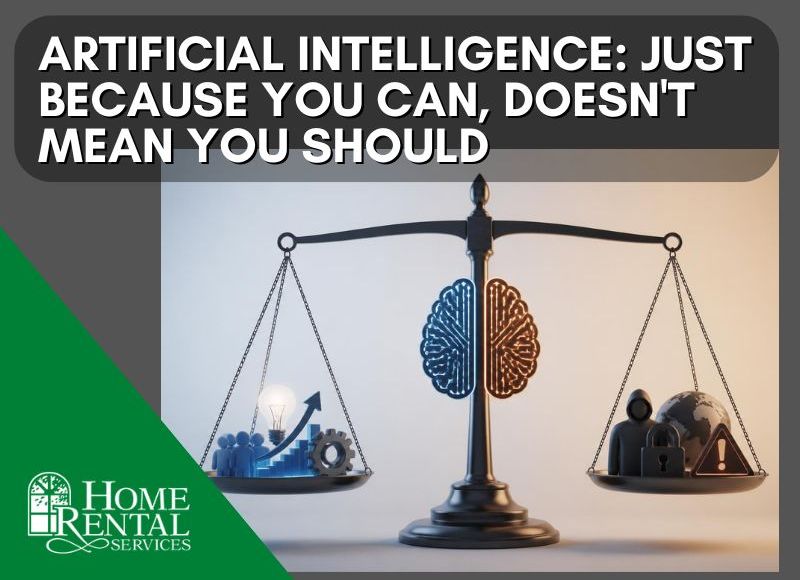
*This article was written with hands and thumbs thunking along on a keyboard with no calculator shortcut key. Well, except for the featured image… our marketing guy used Canva AI to come up with the featured image for me. No baby pandas were harmed during the creation of this blog post.

