 Posted by
 By Paul Branton, Director of Investor Services for Home Rental Services
What’s the real problem with home equity? You can’t spend it. Not directly, anyway.
Building equity is one of the best parts of owning rental property long-term (I’d argue one of the most underappreciated parts, too). But it’s still not the same as cash sitting in your bank account. You can’t hand a contractor a slice of your home’s appreciation to replace a broken water heater.
That’s where a Home Equity Line of Credit, or HELOC, comes in. A HELOC lets you access a portion of that equity without selling the property or refinancing your existing mortgage. That gives you some breathing room for the expenses you didn’t see coming, or the opportunity you did.
The way I’d encourage you to think about a HELOC: it’s not free money. It’s a tool that creates options.
Using a HELOC for Property Reserves
Anyone who’s owned rental property for more than a year or two (probably less) knows that expenses always show up. A roof, an HVAC system, a plumbing issue, a rough turnover, any one of these can cost thousands of dollars, seemingly out of nowhere.
Ideally, you’re keeping enough cash on hand to cover situations like these. But let’s be honest, setting aside cash for every possible emergency isn’t always realistic, especially once a good chunk of your net worth is tied up in the properties themselves.
That’s where a HELOC can add a layer of protection.
Say you keep $25,000 in cash reserves and also have access to a $50,000 HELOC. The HELOC isn’t replacing that cash reserve, it’s backup capital you can tap if a major expense runs past what you’ve got on hand.
And because a HELOC is typically a revolving line of credit, you’re only borrowing what you actually need, when you need it… not pulling the whole amount up front and paying interest on money you’re not using.
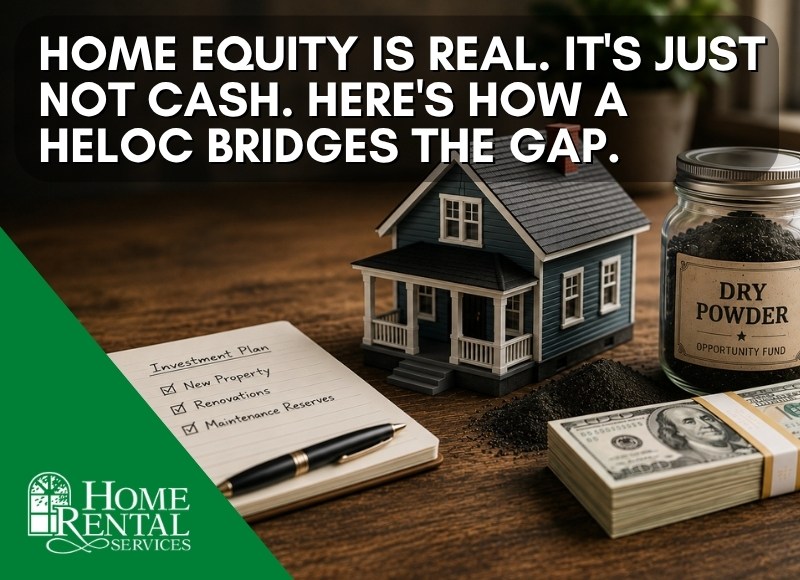
I like to think of it as “dry powder” for your rental portfolio: capital that’s there if you need it, sitting quietly if you don’t.
Using Home Equity for Additional Investments
A HELOC can also put equity you already have to work.
Let’s say you own a property worth $400,000 with a $150,000 mortgage. That’s roughly $250,000 in equity (on paper, anyway) real, but not exactly liquid. You can’t use it to fund your next purchase unless you sell the property or find another way to access it.
Rather than selling, some investors use a HELOC to pull out a portion of that equity.
That money could go toward:
- A down payment on another rental property
- Renovations or improvements
- A value-add investment
- Acquisition costs
- Short-term funding while you line up permanent financing
Done this way, you get to keep the original property and original mortgage terms but put part of its equity to work acquiring or improving another one.
Weighing the Risk: Leverage, Cash Flow, and Reserves
Here’s the part I see people skip past all the time: having access to equity doesn’t automatically make a new investment a good one.
If you borrow $50,000 through a HELOC, that comes with an interest expense and a payment you’re now responsible for. Whatever you’re funding with that money needs to generate enough value or cash flow to justify taking on the debt. Leverage cuts both ways. Always has. And I’d argue the math matters even more when your equity position looks great on paper. A property can carry plenty of equity and still not throw off much cash flow, and the moment you draw on a HELOC, you’ve added a new monthly obligation regardless.
So before you establish or draw on a HELOC, ask yourself a few honest questions:
- What does my cash flow look like now, and what will it look like after?
- How much debt and leverage am I already carrying?
- What cash reserves do I actually have available?
- What happens if interest rates move against me?
- Can I handle a vacancy or a major repair on top of this?
- How does this affect my ability to get financing down the road?
I’ll say it plainly: the goal here isn’t borrowing the maximum amount you’re approved for. It’s keeping a healthy balance between equity, liquidity, cash flow, and debt.
Think of a HELOC as an Option
Honestly, the most valuable thing about a HELOC might just be… having it in place before you need it.
Some investors set up a line of credit while their financial position is strong, then just leave it alone (which, I’ll admit, feels counterintuitive if you’re not used to thinking this way). If an expense pops up, the funds are there. If a good opportunity comes along, you have some capital available to act on it.
Worth noting: HELOCs usually carry variable interest rates, and the property securing the line is on the hook if the debt doesn’t get repaid. Terms, availability, and how much you can borrow all vary by lender and by your own situation.
The Bottom Line
For rental property owners, a HELOC isn’t just about weathering the next big ticket repair, and it isn’t just about funding the next acquisition either. It’s having the cash on hand to quickly address either one of those situations.
That flexibility matters in two very different moments: when something goes wrong, and when something goes right. A major repair needs capital fast. A great investment opportunity often needs capital on a short timeline too. Either way, having equity you can access means you don’t have to sell an asset or refinance your mortgage just to respond.
If you’d like to talk through whether this makes sense for your properties, don’t hesitate to reach out – we’d be happy to help!
Disclaimer: This article is intended for general educational purposes only and should not be considered financial, tax, or legal advice. HELOC availability, terms, interest rates, and tax treatment vary by lender and individual circumstances. Consult with qualified financial, tax, and legal professionals before making borrowing or investment decisions.

