 Posted by
By Paul Branton, Director of Investor Services for Home Rental Services
There is a saying in real estate investing that deserves more attention:
Getting rich slowly is still getting rich.
Investors often celebrate the quick wins. Whether it’s day trading the stock market, cryptocurrency, NFT’s or the latest and greatest investment opportunity, there’s often an emphasis on how quickly you can make money. Real estate is different. While there are opportunities to make money quickly, most of the greatest advantages come from taking a longer-term approach.
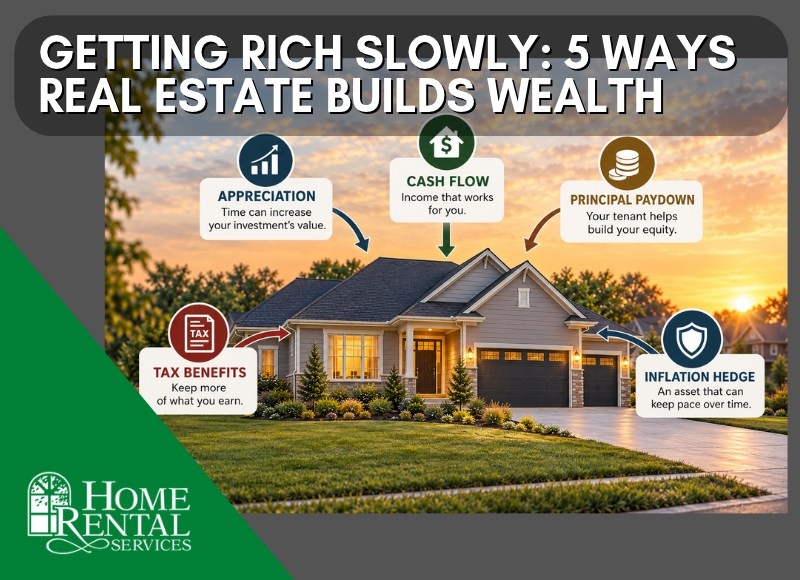
A well-selected rental property doesn’t rely on just one source of return. It can build wealth in five different ways, often simultaneously. It’s the combination of these benefits that makes real estate such a compelling long-term investment.
1. Cash Flow: Income That Works for You
Cash flow is the most obvious benefit of owning rental property and the one that gets talked about the most. After collecting rent and paying the mortgage, taxes, insurance, maintenance, management, and other operating expenses, what’s left is your cash flow.
Ideally, you’ve put an asset in place that generates income every month without having to sell or liquidate your investment. Cash flow can supplement current income, fund future investments, build reserves, or eventually provide meaningful retirement income.
The goal isn’t necessarily to maximize monthly income at the expense of everything else. A solid investment balances cash flow with the property’s long-term potential.
2. Principal Paydown: Your Tenant Helps Build Your Equity
One of the more overlooked benefits of rental ownership is principal paydown.
With a financed property, a portion of each mortgage payment reduces the outstanding loan balance. Over time, you own more of the property and owe less.
Here’s where it gets interesting: in most rental situations, it’s the tenant’s rent payment that helps fund the mortgage. Your tenant occupies the property, and the rent helps reduce your debt and increase your equity.
The longer you own the property, the more this can add up. Eventually, paying off the mortgage can eliminate one of your largest expenses and create a significant source of ongoing income (increased cash flow.)
3. Appreciation: Time Can Increase Your Investment’s Value
Real estate has historically appreciated over time… although appreciation is never guaranteed and varies by location, property type, and market conditions.
Unlike cash flow and principal paydown, appreciation doesn’t put money in your pocket today. It increases the value of the asset you own. If a property purchased for $300,000 is worth $375,000 down the road, that’s $75,000 in additional property value without having to sell it.
If you used financing, you’re benefiting from appreciation on the entire property’s value, not just the cash you initially invested. Leverage can magnify gains, but it can also magnify losses when values decline.
The advantage of appreciation is often realized by investors willing to hold good properties through changing market cycles rather than trying to time the market.
(See my previous post about utilizing this appreciation by way of a home equity line of credit)
4. Tax Benefits: Keeping More of What You Earn
Real estate offers tax advantages that can improve an investment’s overall return.
For starters, the IRS generally allows residential rental property owners to depreciate the building’s value over 27.5 years. This is a non-cash expense, meaning you may be able to claim depreciation even though you aren’t spending that money each year.
Depending on your circumstances, mortgage interest, property taxes, insurance, maintenance, management fees, and other eligible operating expenses may also be deductible.
When selling, investors may also be able to defer capital gains taxes through a 1031 exchange by reinvesting proceeds into another qualifying investment property. Tax rules, depreciation recapture, and limitations on rental losses can make this complicated, so work with a qualified tax professional. Properly understood, the tax treatment of real estate can be a meaningful part of its investment appeal.
5. Inflation Hedge: Owning an Asset That Can Keep Pace
Inflation gradually reduces the purchasing power of money. What costs $100 today may cost considerably more ten or fifteen years from now. (I feel like we witnessed this recently… Say 2015 to 2025.)
Real estate can provide a degree of protection because property values and rental rates have the potential to increase over time. As the cost of living rises, replacement costs for homes, labor, and materials generally rise too. Rents can also adjust with market conditions.
Meanwhile, with a fixed-rate mortgage, your principal and interest payment generally remain the same throughout the loan term. Consider that combination: rental income may increase while your mortgage payment stays relatively consistent.
What Could This Look Like Over 10 Years?
Let’s use a hypothetical $300,000 rental property to put these concepts into perspective.
Assume an investor puts 20% down ($60,000) and finances the remaining $240,000 with a 30-year fixed mortgage at 6.5%. Also assume the property generates $300 per month in positive cash flow after normal operating expenses and mortgage payments, and appreciates at an average of 3% annually.
It’s important to remember that rental properties aren’t without expenses. Maintenance, unexpected repairs, capital improvements, and periods of vacancy can all eat into annual income. A smart investor plans for these expenses and maintains reserves rather than treating every dollar of cash flow as spendable income.
After 10 years, here’s what those assumptions could produce:
- Cash flow: Up to $36,000 over 10 years, assuming monthly cash flow remains consistent and before any additional unplanned expenses.
- Principal paydown: Approximately $36,500 in mortgage balance reduction.
- Appreciation: At 3% annual appreciation, the property would be worth approximately $403,000, an increase of about $103,000.
- Tax benefits: Depreciation and eligible operating expenses may provide tax advantages along the way. The actual benefit depends on the investor’s tax situation.
- Inflation hedge: Rental rates and property values may rise over time, while the fixed principal and interest payment remains consistent.
Taken together, cash flow, principal paydown, and appreciation represent up to approximately $175,500 in cumulative income and increased property value over the 10-year period, before taxes, selling costs, and other changes in the investment. That’s in addition to owning an asset that may continue generating income.
Note: This is an illustration, not a guarantee. Actual results depend on financing, expenses, vacancies, repairs, market conditions, taxes, and the property’s performance.
The Bottom Line
What makes real estate investing attractive isn’t any one of these five benefits. It’s how they all work together.
If you take the slow and steady approach, you’ll be collecting rental income, having a tenant help pay down your mortgage, benefiting from appreciation, taking advantage of available tax deductions, and adjusting rents as inflation changes the market.
Of course, real estate isn’t without challenges. Properties always require maintenance, tenants sometimes don’t pay on time, vacancies happen, and markets go through cycles. Not every property is a good investment, and simply owning real estate doesn’t guarantee financial success.
Fortunately, you don’t need to hit a home run with every investment! Sometimes you just need to buy a good property, put a sound plan in place, and give it time to score some runs in multiple innings. Because when all five wealth-building mechanisms are working together, slow and steady can add up to something pretty substantial. We call it getting rich slowly.

